A commercial real estate deal almost never comes down to one person. Behind any purchase, development, or lease sits a group of specialists, each responsible for a different piece of the puzzle. For those new to the industry, the titles and roles can blur together quickly.
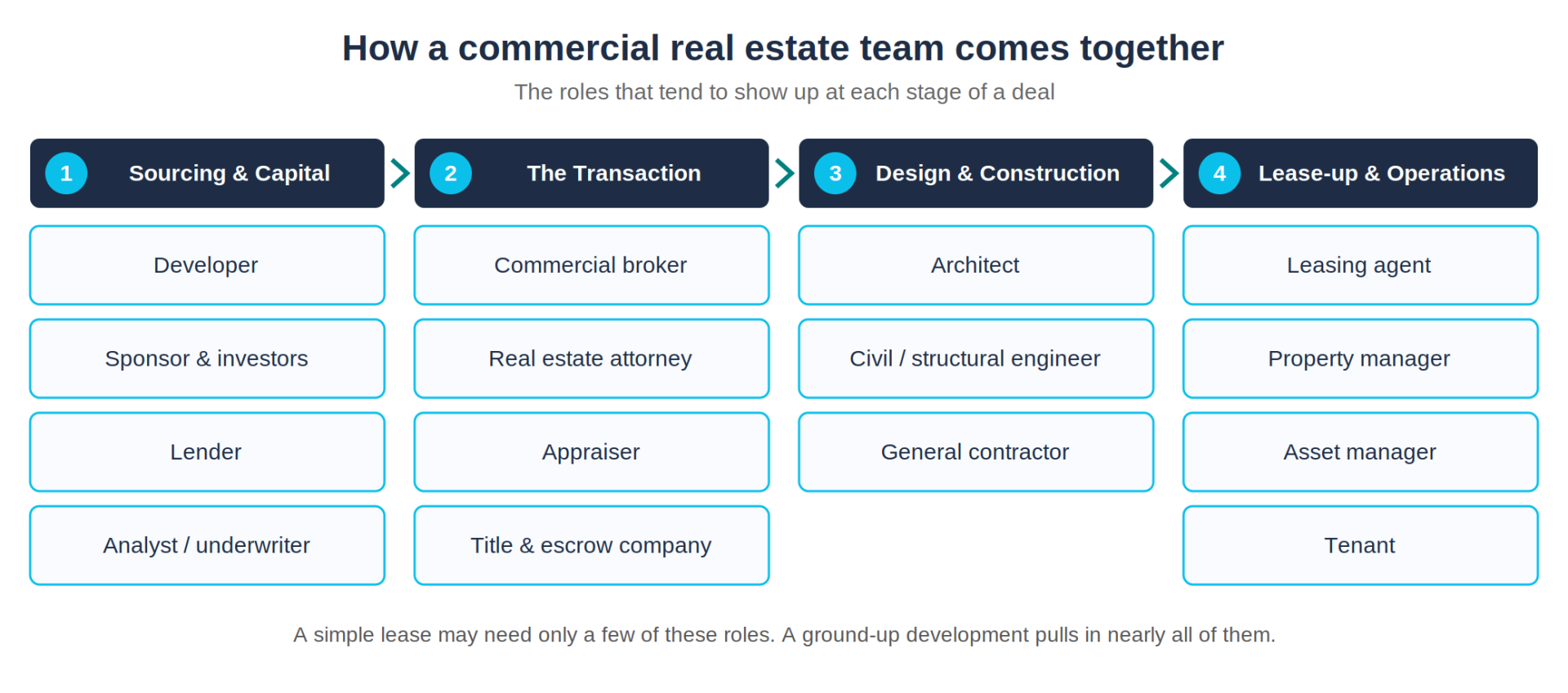
Therefore, to help you get clarity of who does what, here are fifteen of the most common roles on a commercial real estate team. We have grouped by where they tend to show up in a deal, along with what each one actually does.
Key Takeaways
- A commercial real estate deal usually involves a dozen or more specialists, not the single agent a home sale might.
- The team roughly breaks into four stages: sourcing and capital, the transaction itself, design and construction, and lease-up and operations.
- Some roles overlap. A developer may also be the sponsor raising capital, and one broker may handle both a sale and a lease.
- Investors lean most on the capital and advisory roles, while occupiers lean most on brokers and attorneys.
- Knowing who does what helps you assemble the right team and avoid paying for roles you do not need.
Of course, not every deal needs all fifteen. A simple lease might involve two or three of these people, while a ground-up development could pull in nearly all of them. Here is how the team tends to come together as a deal moves from idea to operating property. For a refresher on what counts as commercial property in the first place, our guide to what qualifies as commercial real estate is a good starting point.
Sourcing and Capital
The earliest roles get a project off the ground and funded. The developer identifies the opportunity, secures the site, and coordinates much of the team from start to finish. A sponsor, sometimes the same party, organizes the deal and raises equity from investors, who contribute capital for a share of the returns. Our investor’s guide to working with CRE brokers covers that side in more depth. The lender provides the debt that completes the financing. That could be a bank, an agency, or a life company. And the analyst, or underwriter, builds the models and market research that tell everyone whether the numbers work.
The Transaction
Once a deal is live, a second group handles the buying and selling. A commercial real estate broker represents the buyer or the seller, brings market access, and negotiates the terms. On larger deals the listing side and the tenant or buyer side are usually separate people, a split we break down in tenant broker versus listing broker. A real estate attorney reviews contracts, runs due diligence, and steers the closing. An appraiser gives an independent estimate of value, the number the lender relies on. A title and escrow company confirms clear ownership and holds the funds until everything is signed.
Design and Construction
For any development or major renovation, the build team takes over. An architect designs the building and its spaces. A civil or structural engineer handles the technical side, from site work to making sure the structure stands up to code and conditions. And a general contractor runs the actual construction, hiring and managing the subcontractors who handle electrical, plumbing, HVAC, and the rest.
Lease-up and Operations
After the keys change hands, the focus shifts to filling and running the property. A leasing agent markets vacant space and brings in tenants who fit the building. A property manager handles the day-to-day: operations, maintenance, and tenant relationships. An asset manager takes the longer view, working to improve the property’s financial performance over time, often across several assets at once. And the tenant, easy to overlook as a team member, is the occupant whose rent ultimately supports the whole investment. The structure of that relationship is set by the type of lease they sign.
Building the Right Team
The full roster shows up only on the largest, most complex deals. A small business signing a lease may work with little more than a broker and an attorney. A ground-up development pulls in nearly everyone here. The practical move is to match the team to the deal. Bring in each role when the work calls for it, and lean on the people whose expertise covers the gaps in your own. If you are weighing whether to bring on representation at all, our look at the pros of working with a commercial real estate broker is a useful place to start.
Frequently Asked Questions
How many people are involved in a commercial real estate deal?
It varies with the deal’s size and complexity. A simple lease might involve a broker and an attorney, while a ground-up development can pull in fifteen or more specialists.
What is the difference between a property manager and an asset manager?
A property manager handles the day-to-day operations of a building, like maintenance and tenants. An asset manager looks after the investment’s financial performance over time, often across several properties.
Do I need a broker to buy or lease commercial real estate?
You are not required to, but a broker brings market access and negotiating experience, and on the tenant or buyer side their fee is usually paid by the landlord or seller.
What does a commercial real estate developer do?
A developer initiates a project, secures the site and financing, and oversees design and construction, often coordinating most of the other roles on this list.
What is the difference between a sponsor and an investor?
A sponsor organizes and runs the deal, often investing alongside others and raising the rest of the capital. Passive investors contribute money but leave the day-to-day decisions to the sponsor.
The post Fifteen Key Roles on a Commercial Real Estate Team appeared first on CommercialCafe.