Some of the busiest corners in the country are occupied by buildings whose tenants do not own the land beneath them. A fast-food location, a bank branch, a regional mall: many of these sit on leased ground, with the business owning the building and renting the dirt it stands on. That arrangement is a ground lease, and it appears in more commercial deals than most people expect.
It reaches the top of the skyline too. Someone owns the Chrysler Building; Cooper Union, a private college, owns the land beneath it, and has since 1902. When the tower’s leaseholder fell behind on rent in 2024, the college moved to take back the building and everything in it. Own the tower, rent the dirt, and the dirt sets the terms.
This guide explains what a ground lease is, how the rent and reversion terms work, the difference between subordinated and unsubordinated structures, and when leasing land instead of buying it makes sense for a business or an investor.
Key Takeaways
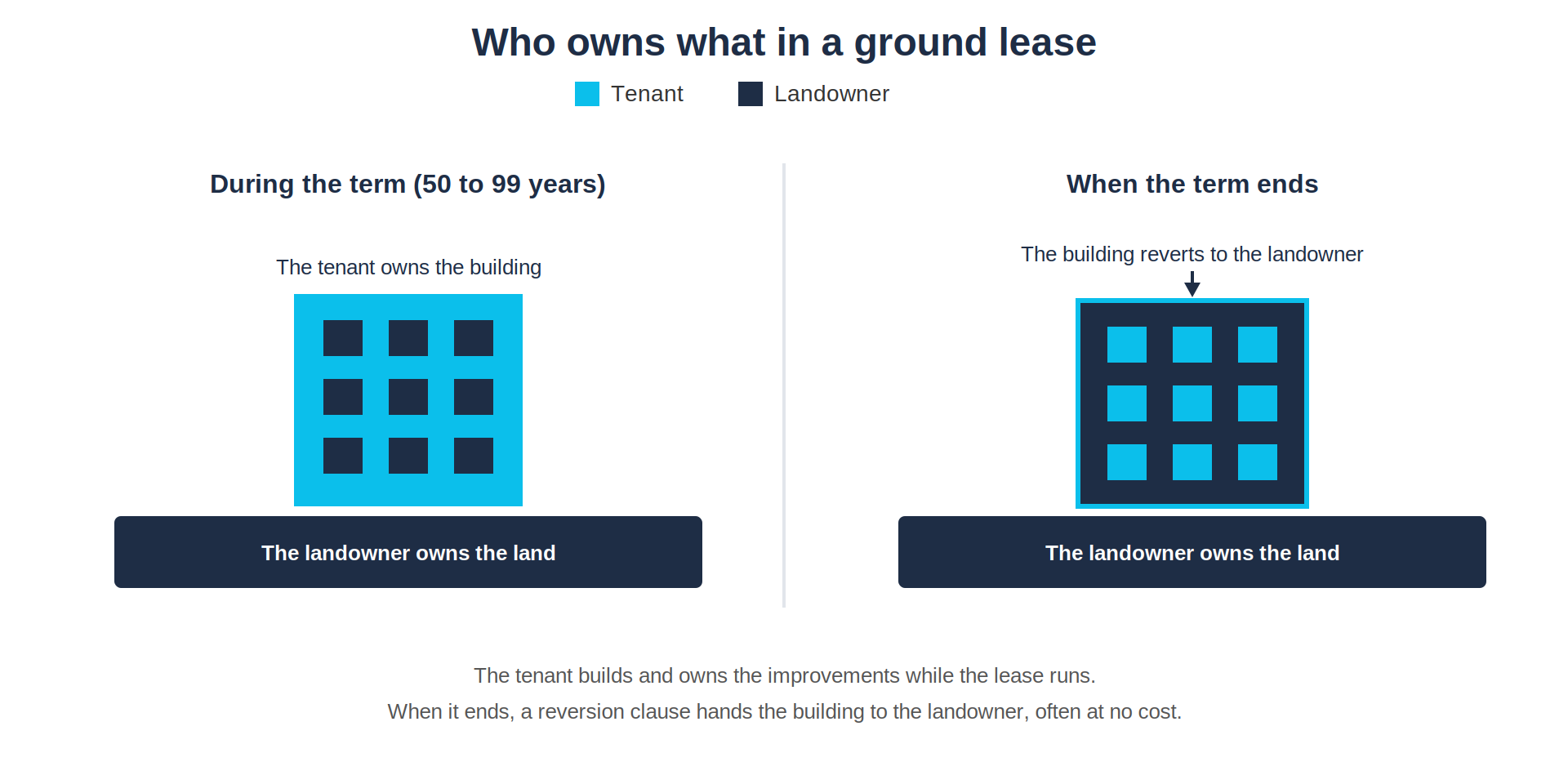
- A ground lease is a long-term lease of land only. The tenant builds on the site and owns the improvements during the term, while the landowner keeps the land.
- Terms usually run 50 to 99 years, long enough for a tenant to construct a building and recover the cost before the lease ends.
- Most ground leases are structured like a triple net lease: the tenant pays property taxes, insurance, and maintenance on top of rent.
- At the end of the term, the building and improvements typically revert to the landowner, often at no cost. A reversion clause sets this out.
- The split between subordinated and unsubordinated leases comes down to who has priority if the tenant defaults on construction financing, which affects how easily the tenant can borrow.
- Ground leases suit long-horizon owners such as institutions, REITs, and family trusts, and tenants that want a prime location without the capital to buy it. They rarely fit small businesses or short-hold investors.
What Is a Ground Lease?
A ground lease, sometimes called a land lease, is an agreement in which a tenant leases a parcel of land and gains the right to develop it. The tenant constructs a building or other improvements and uses the site throughout the lease, but the landowner keeps title to the land itself. That separation between who owns the land and who owns the building is the defining feature, and it carries through everything else about how these leases work.
Because the tenant is putting up a building they will not own forever, ground leases run long. Terms of 50 to 99 years are common, which gives the tenant enough time to design, build, operate, and recover the cost of the improvements. If you are still getting comfortable with the language around leases, our rundown of commercial real estate terms covers the basics that come up here.
How a Ground Lease Works
The mechanics are clearer once you separate the land from what sits on it.
Rent and escalations. The tenant pays the landowner for the use of the land, and most ground leases build in escalation clauses, so the rent rises on a set schedule or tracks an index such as the Consumer Price Index. If you want to see how base rent, escalations, and operating costs fit together in a commercial deal, our guide on how to calculate commercial rent walks through the math.
Expenses. Ground leases are typically structured as triple net (NNN), which means the tenant covers property taxes, insurance, and maintenance in addition to rent. Triple net is one of three common lease structures. Gross, modified gross, and net leases divide a building’s running costs in different ways, and it’s the difference to understand before you sign.
Reversion. At the end of the term, the land and the improvements on it usually return to the landowner, and a reversion clause sets this out. In practice it means the tenant hands back not just the land but the building they paid to construct, which is why the length of the term matters so much to the tenant’s return.
Subordinated vs. Unsubordinated Ground Leases
Tenants almost always borrow to fund construction, and a lender wants to know where it stands if the tenant defaults. That question is what separates the two main types of ground lease.
In a subordinated ground lease, the landowner agrees to take a lower priority than the construction lender. The land effectively becomes part of the collateral, so if the tenant defaults, the lender can foreclose on the land along with the building. That makes financing easier to obtain, but it puts the landowner’s asset at risk.
In an unsubordinated ground lease, the landowner keeps first priority. If the tenant defaults, the lender can pursue the building and the tenant’s other assets but cannot take the land. This protects the landowner, though it makes lending riskier, so financing can be harder to arrange and landowners often accept lower rent in exchange.
How the two ground-lease structures compare for the tenant and the landowner:
| Subordinated | Unsubordinated | |
|---|---|---|
| Landowner’s priority if the tenant defaults | Lower than the lender | Higher than the lender |
| Land pledged as loan collateral | Yes | No |
| Ease of financing for the tenant | Easier | Harder |
| Risk to the landowner | Higher: the land can be lost | Lower: the land is protected |
| Typical rent | Often higher | Often lower |
Ground Lease vs. a Traditional Lease
A traditional commercial lease covers both the land and an existing building, and the tenant moves into space someone else built. A ground lease covers raw or underused land, and the tenant builds. The first is about occupying finished space; the second is about controlling a site long enough to develop it.
 That makes the ground lease closer to a middle path between renting and owning. The tenant gets long-term control of a location and ownership of the building during the term, without the capital needed to buy the land. If you are weighing the broader question of leasing versus owning your space, our piece on buying versus leasing office space lays out the trade-offs.
Pros and Cons of a Ground Lease
Like any structure, a ground lease helps one side in ways it constrains the other. Here is how it tends to net out.
For the tenant, the appeal is access and cash flow:
- It opens up prime land that may not be for sale, without the capital required to buy it.
- Lower upfront cost frees cash for construction and operations.
- Lease payments are generally deductible as a business expense.
The trade-offs for the tenant are real:
- No ownership of the land, and the building reverts at the end of the term.
- A long commitment with rent that escalates over time.
- Financing can be complicated, especially under an unsubordinated lease.
For the landowner, the draw is income without giving up the asset:
- Steady long-term income while keeping ownership of the land.
- A functioning building usually returns at the end of the term, often raising the land’s value.
- Keeping the land avoids triggering the gain a sale would.
The landowner gives something up too:
- Capital stays tied up in land for decades.
- Under a subordinated lease, the land itself is at risk if the tenant fails.
Tax treatment depends on your situation and where the property sits, so confirm the specifics with a tax advisor or attorney before you rely on them.
When a Ground Lease Makes Sense
Ground leases reward patience on both sides, so they tend to suit specific players. On the ownership side, institutions with long horizons, including universities, government bodies, family trusts, and real estate investment trusts, use them to earn income without parting with valuable land. On the tenant side, national retail and restaurant chains use ground leases to secure high-traffic corners they could not otherwise buy, and developers use them to build when purchasing the land outright would tie up too much capital.
They are a poor fit for others. If you need flexibility, or you plan to sell within a few years, the long term and the reversion will work against you. Everything comes down to one question: can you wait? A landowner who can hold for decades earns income without selling. A tenant who can commit for the full term gets a prime location without the price of buying it. If your plan depends on owning the land one day, or on moving before the lease matures, look elsewhere.
If you are evaluating whether a site suits a ground lease or an outright purchase, it helps to see what is actually on the market. You can browse commercial properties and land for lease or sale on CommercialCafe to compare local pricing and availability. And because ground leases are heavily negotiated, a tenant broker who knows the submarket can make a meaningful difference in the terms you end up with.
Frequently Asked Questions
What is the difference between a ground lease and a land lease?
They are the same thing. Land lease is simply another name for a ground lease, an agreement to lease land while the tenant develops and uses it.
How long does a ground lease last?
Most run between 50 and 99 years. The long term gives the tenant time to build and recover the cost of the improvements before the land and building return to the owner.
Who pays property taxes on a ground lease?
In most cases the tenant does. Ground leases are usually structured as triple net, so the tenant covers property taxes, insurance, and maintenance along with rent.
What happens to the building at the end of a ground lease?
Under a standard reversion clause, the building and any improvements pass to the landowner, often at no cost. Some long leases instead require the tenant to remove the building first.
Is a ground lease a good idea for a small business?
Usually not. The long commitment, escalating rent, and loss of the improvements at the end make ground leases better suited to large tenants and long-horizon owners than to small businesses that need flexibility.
The post What Is a Ground Lease in Commercial Real Estate? appeared first on CommercialCafe.