Before you buy a property, sign a lease, or draw up plans to develop a site, one local rulebook decides what you are actually allowed to do with it. Zoning laws govern how land can be used and what can be built on it, and they can make or break a deal long before financing or design enters the conversation.
This guide covers what zoning is, the main categories you will run into, the three ways to change what a property allows, and why checking zoning early is one of the most practical steps in any commercial deal.
Key Takeaways
- Zoning laws are local rules that divide land into districts and set what each one can be used for, along with limits on height, density, setbacks, and parking.
- The main categories are residential, commercial, industrial, mixed-use, and special purpose, and most have subcategories with their own rules.
- A property’s zoning has a direct effect on its value and its potential. The same building can be worth very different amounts depending on what the zoning allows.
- There are three main ways to change what you can do: a variance, a conditional use permit, and rezoning, in rough order of how much you are asking.
- Several local bodies weigh in on a change, usually zoning staff, a planning commission, and the city council, often after public hearings.
- Checking zoning belongs early in due diligence. Finding a conflict after you have committed is one of the more expensive mistakes in commercial real estate.
What Zoning Laws Do
Zoning determines how land is used and what can be built on it. Local governments divide a municipality into districts, then set rules for each one, both for use (what kind of activity is allowed) and for form (height, density, setbacks, lot size, parking, and green space). The aim is to keep incompatible uses apart, protect public health and safety, and guide how a place grows.
Most cities work from a comprehensive or master plan, a long-range vision for development, and use zoning as the tool that turns that plan into enforceable rules. For anyone working in commercial real estate, the practical effect is simple: zoning sets the outer limits of what a property can become.
The Main Zoning Categories
Almost every property falls into one of a handful of broad categories, and most of those carry subcategories that get more specific.
| Zoning category | Typical uses | What it means for CRE |
|---|---|---|
| Residential | Single-family homes, apartments, condos | Apartment buildings of five or more units are often treated as commercial; density and height caps are common. |
| Commercial | Retail, restaurants, offices, hotels | Subzones (often labeled C-1, C-2, and so on) separate small neighborhood retail from larger districts and office use. |
| Industrial | Manufacturing, warehousing, distribution | Split into light and heavy; heavy industrial sits farthest from homes and carries the most rules on noise and emissions. |
| Mixed-use | Combined residential, retail, and office | Encourages live-work-play districts and suits infill and conversions, with rules that balance the different uses. |
| Special purpose | Agriculture, schools, hospitals, airports | Covers anything outside the standard buckets and often needs its own approvals and study. |
In dense urban areas these lines blur, and overlay districts or planned-development zoning can add extra rules on top of the base category. The exact labels and codes vary from one municipality to the next, so the category is a starting point, not the final word.
How to Change What a Property Allows
If a property’s current zoning does not fit your plans, you are not necessarily stuck. There are three main routes, and they differ mostly in how much you are asking the municipality to grant.
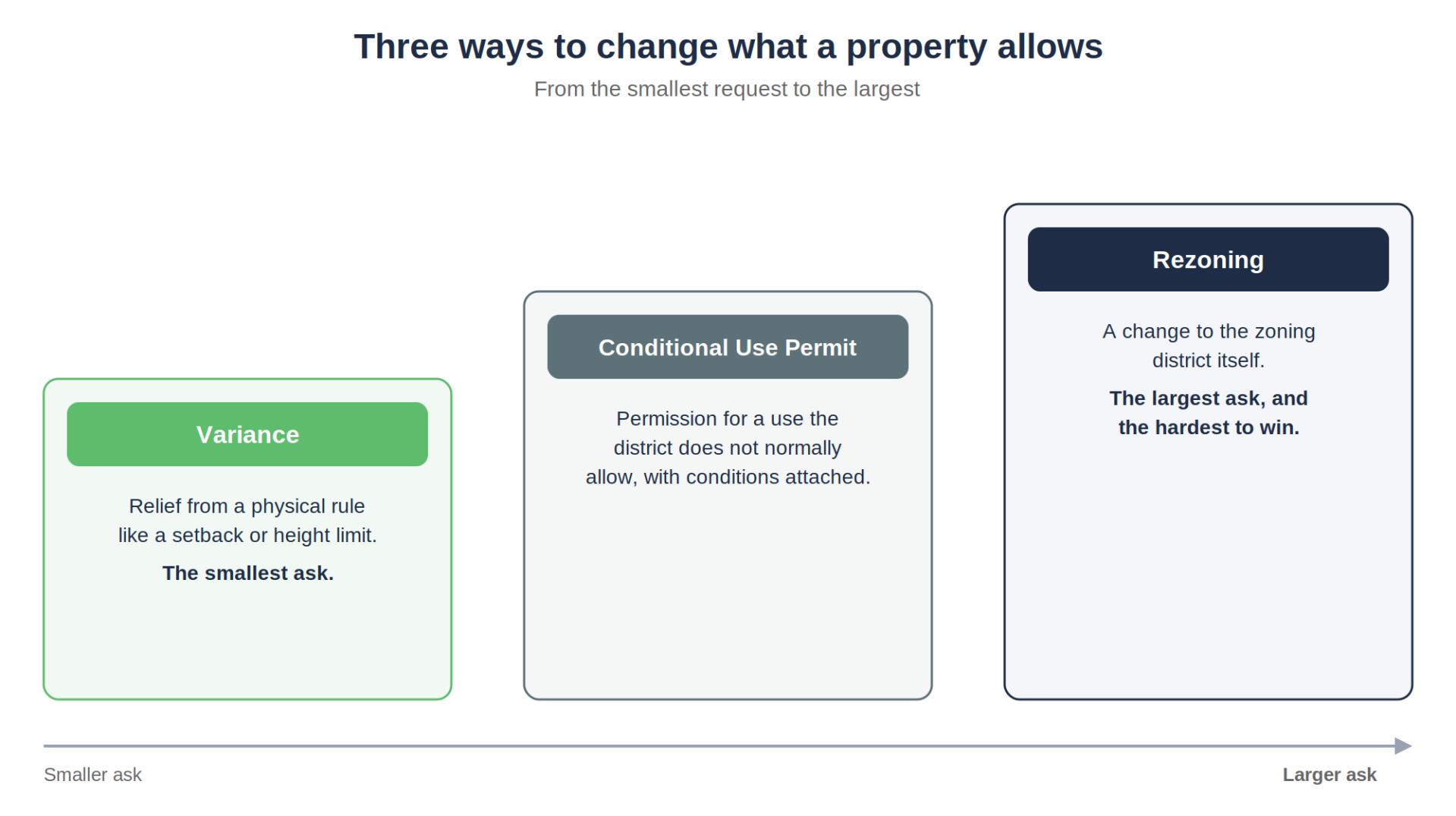
Variance. Relief from a physical rule such as a setback, height limit, or lot requirement, usually granted for a genuine hardship. The smallest ask.
Conditional use permit. Permission for a use the district does not normally allow, such as a daycare in a residential zone. The use is approved with conditions attached.
Rezoning. A change to the property’s zoning district itself, for example from industrial to commercial. The largest ask, and the hardest to win.
Whichever route you take, a few local bodies have a say. Zoning staff are usually the first stop: they check your application against the existing ordinance and make a recommendation, but they do not approve or deny it. A planning commission then advises the city council, and the council makes the final decision, often after public hearings where neighbors and other affected parties can weigh in. None of it is guaranteed, and the process takes time, which is why it pays to understand the odds before you build a plan around a change.
Zoning rules, labels, and procedures vary widely by municipality, so treat this as a general guide and confirm the specifics with the local planning authority or a land-use attorney before you act.
Why Zoning Matters Before You Buy or Lease
Zoning has a direct effect on value. A site that allows a denser, higher, or more commercial use is usually worth more than an identical site with tighter limits, because it can do more. That same logic is why a zoning conflict discovered late can be so costly: if your intended use is not allowed and a change falls through, the deal may no longer work at all.
This comes up constantly with redevelopment. Converting an older building to a new use, the heart of adaptive reuse, frequently depends on a rezoning or a conditional use permit. The same is true when an investor wants to push an office site toward residential or mixed-use. Because lenders and use rules differ across the main types of commercial real estate, confirming the zoning fits the plan is part of underwriting the deal, not an afterthought. If you are weighing whether to buy or lease, zoning belongs in that analysis too.
How to Check a Property’s Zoning
Start with the municipality. Most cities publish a zoning map and the full zoning ordinance online, and the local planning or zoning department can confirm a parcel’s district and the uses it permits. During a purchase, a zoning report is a standard part of due diligence, and for anything complex, such as a nonconforming use that predates the current rules or a change you intend to pursue, a land-use attorney is worth the cost. You can also browse what is actually available and how it is positioned on CommercialCafe while you weigh a site against your plans.
Frequently Asked Questions
What are the main types of zoning?
Residential, commercial, industrial, mixed-use, and special purpose, with most carrying subcategories that set more specific rules on use, density, and form.
What is the difference between a variance and a conditional use permit?
A variance grants relief from a physical rule like a setback or height limit, usually for a hardship. A conditional use permit allows a use the district does not normally permit, such as a daycare in a residential zone.
Can you change a property’s zoning?
Yes, through rezoning, a conditional use permit, or a variance, depending on what you need. Each goes through a local review process and is never guaranteed.
How do I find out how a property is zoned?
Check the municipality’s zoning map and ordinance, contact the local planning or zoning department, or order a zoning report as part of due diligence.
Why does zoning matter when buying commercial real estate?
Zoning decides what you can do with the property, which affects its value and whether your plans are even possible. Confirming it before you buy avoids costly surprises.
The post Zoning Laws: A Practical Guide for Commercial Real Estate appeared first on CommercialCafe.