The surge in homebuilder merger and acquisition (M&A) transactions over the past 12 months raises questions about the potential for more deals, their drivers and their mechanics. Will builder M&A deals continue despite low consumer confidence, elevated mortgage rates, and sluggish new home sales? Could we see a mega-merger among new home sector giants?
Margaret Whelan, Founder and CEO of Whelan Advisory, LLC, generously shared her expectations and answered my questions. Margaret and her team expertly advise and support sellers and provide introductions to capital. She has closed 49 transactions totaling $15+ billion in volume over the last eight years, earning a reputation in the industry as ‘The Closer.’
Margaret has qualified insights into builder M&A trends.
Scale is the driver behind recent big M&A transactions
“Eleven builders exceed 10,000 closings annually, and just eleven major housing markets exceed 10,000 single-family permits annually,” Whelan observes. “Builders seeking greater scale must look to acquisitions.”
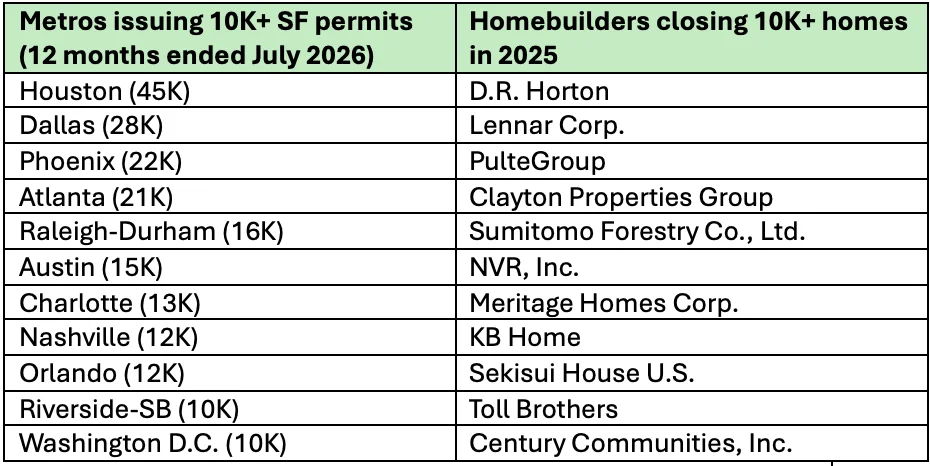
The implication is that scale is scarce, and it’s hard to build from scratch.
“How do you get scale without doing M&A?” Whelan asked. “There’s a lot of dumb tax and a lot of learning curve and drag on profitability if you try to grow organically.”
Scale: a look back
In fact, scale has become more relevant than public versus private status. Starting with KB Home’s public offering in August 1986, going public gave builders access to corporate-grade capital, eliminating the headaches of securing financing for each new community and the requirements for personal guarantees. Today, opportunistic, cheaper capital is widely available for larger private builders, with terms that align with housing industry practices. However, many smaller local builders still finance each new community and provide guarantees.
Larger scale provides a range of benefits. 1) Fixed and overhead costs are allocated across more closings, 2) the promise of steady work enables the purchasing team to negotiate lower labor and materials costs per unit, which is particularly relevant in a labor-constrained market, and 3) local teams can achieve more depth in key markets.
This recap of selected 2026 M&A transactions highlights the range of buyers seeking more scale:
- Two public homebuilders: Dream Finders Homes and Beazer Homes announced a definitive acquisition agreement in August, after months of heated valuation negotiations. If the transaction closes in the 4th quarter as scheduled, Dream Finders will jump in HousingWire Homebuilder Rankings to No. 6 nationally, with 13,035 combined closings (2025 data) from #14 with 8,608 closings.
- A housing sector behemoth and a public homebuilder: Berkshire Hathaway, Inc. completed its July acquisition of Taylor Morrison Homes for $8.6 billion in an all-cash transaction. Taylor Morrison joins the Clayton Properties Group, which comprises 15 regional and local production-volume builders that Berkshire has acquired over time. The roughly 25,000 combined closings would have ranked #4 nationally in 2025.
- A Japanese powerhouse and a public builder: Sumitomo Forestry Co., Ltd. acquired Tri Pointe Homes in May, converting Tri Pointe into a wholly owned subsidiary and taking it private. With roughly 15K combined deliveries annually, Sumitomo now ranks 5th nationally.
- Two private builders: Southeast regional builder Eastwood Homes expanded its footprint through the May acquisition of Atlanta-based Peachtree Building Group. This transaction confirms that the opportunity and appeal of consolidation are not limited to publicly traded U.S. and Japanese homebuilding companies.
Margaret and I agree that smaller public builders are under pressure to scale and diversify geographically. We may see more M&A deals among smaller-cap public builders, or large-cap U.S. builders, Japanese-owned builder groups, or private equity may scoop them up. In recent years, private equity groups acquired former public builders The New Home Company and LandSea Homes, and the Whelan Advisory team negotiated Defy Investments’ acquisition of the private builder Davis Homes in Indianapolis.
What’s next for scale? A megamerger?
I have long been skeptical that two large public builders would merge, given their different leadership styles and cultures and possible antitrust considerations. Whelan sees it differently. “I think it is definitely possible and probable,” she said. “The reason is that scale matters so much, more than social issues at this point.”
She also dismissed antitrust considerations as an obstacle, noting that the housing industry remains fragmented across price points, product types and submarkets. Peer-to-peer combinations among mid-sized builders are likely as well, she explains, usually triggered by succession. “When a stronger personality or owner retires, it’s a good opportunity for somebody else to take over.”
Patient money, and a seller’s market
“Capital availability is irrationally exuberant,” Whelan exclaimed. “There’s just so much capital chasing the housing market.” Capital from insurance companies and foreign investors is opportunistic, patient and typically aligned with U.S. private equity groups. This capital flow makes M&A deals easier to finance. Land banking, which wasn’t available when I was structuring transactions in the 1990s and 2000s, lets acquirers pick up large lot positions without carrying them all on the balance sheet. Whelan noted that buyers frequently bring their own land banker to the table.
Challenging market conditions: a private builder motivator
Consumers have valid reasons to feel anxious, with rising mortgage rates, inflation pushing living expenses higher, and a barrage of worrisome headlines about geopolitical risks. Competition remains intense for the smaller pool of buyers, and builders’ costs are rising due to tariffs and labor shortages tied to immigration enforcement. For private builders carrying personal guarantees, Whelan sees their anxiety, stating, “The sharp increase in cancellation rates is alarming in a deteriorating market. It makes them nervous.”
An unusual pricing dynamic that signals a seller’s market
“We’re selling private builders at a massive premium to where public builders are trading, which is highly unusual,” she explained. “You’d always look at where the publics were trading and apply a discount to that. Now you look at where they’re trading and apply a premium. It’s just a function of supply and demand in the quest for scale.”
Whelan Advisory prices acquisitions using forward-looking cash flows, similar to the forward-looking EBITDA approach my team used. However, the seller’s lot positions often drive the premium. “I think three years of supply is still Goldilocks, not too hot, not too cold,” Whelan noted. “But if you have lined up five or ten years of lots in an attractive market, you’ll get a premium for that.”
The seller’s premium goes to companies prepared to actively engage with buyers. Whelan warned that some owners go to market mainly to see what they might be worth. They don’t really plan to sell and might burn bridges in a relatively small industry.
If you are a private builder quietly weighing your options, Whelan’s message is that the window is open. Buyers are motivated, capital is plentiful, and well-prepared sellers with strong market positions are commanding premiums. Her advice: call her to start a confidential conversation.