Focus on the things you can control.
At a time when $20 million, $50 million, $100 million, $500 million, up to $33 billion homebuilding firms need to discern and act decisively to ride out a 2027 [and possibly 2028] market rife with challenges, with no outside help, the nicest, common turn of phrase is to focus on what you can control.
Entirely too abstract, however, especially in a market headed sideways or down.
What’s not abstract is job sites with a dumpster here and a dumpster there, full of construction materials not used on the job. What’s not abstract are scheduling mix-ups or a construction document error that adds five days to the start-to-completion cycle. What’s not abstract is a chief accounting officer giving notice of departure two weeks into a fourth quarter that’s a knife’s edge, with homes near completion but not yet sold and a pile of invoices still to be paid. What’s not abstract is the patience it takes to say no to a land deal whose price has dropped, knowing you’ll need it in 18 to 24 months, even though it may sell for an even lower price six to nine months from now.
Controlling what you can in the blue-collar-white-collar business of running a homebuilding company can be a rough pivot for an organization leader who’s been getting a lot right, with tailwinds helping growth and profitability, and an outlook of more good things to come.
“I’ve read business books about companies that hit the $20 million to $30 million point in annual revenue, and that’s known as a milestone many companies don’t survive,” Jim Schaefer, founder and CEO of Annapolis, Maryland-based Schaefer Homes, tells HousingWire TBD in the days after he attended the HousingWire Homebuilder Summit in Dallas. “We’re right there. It’s where you have to professionalize your business like a big company, but you’re not big enough to afford those same resources, talent, and access to patient capital. It’s an excruciating point, so it’s valuable beyond words to be able to spend time with homebuilding founders and CEOs who’ve been exactly where I am right now with this young business and learn from them.”
Schaefer Homes, which recorded 31 closings in 2025, a 68% increase from a year earlier, expects more modest 30% growth by year-end. But in a market outlook devoid of significant tailwinds over the next 12 to 24 months, Schaefer’s plan calls for doubling the 10-year-old firm’s growth, from approximately 40 homes this year to 80 next year and 160 in 2028.
“We can’t plan on interest rates to come our way, nor input cost pressures easing, or even much improvement on our labor or land costs,” Schaefer tells us. “We’re still a relatively young company and we have so much to learn when it comes to the practical, operational practices we need to know to improve.”
Schaefer, a third-generation homebuilder, learned to build one new, ground-up home at a time, not 20 homes at once, with 20 more in the pipeline and 80 more budgeted for next year. Dumpsters full of wasted framing and rough-trade materials get his goat, so sitting next to Houston-based Partners in Building Executive Chairman Jim Lemming, who recently passed the leadership mantle to his son Chris, at this week’s Summit wasn’t at all about vague imperatives to focus on what you can control.
“Jim went step-by-step through how to walk through one of our homes the first time we build it and capture the data at the bill of materials level, building member by building member and generating accurate take-offs to hand over to purchasing,” Schaefer says. “Getting to spend that kind of time with Jim was priceless. You don’t get that in any other homebuilding conference event I’ve ever been to.”
That exchange goes well beyond a useful construction-management technique. For a young builder trying to double production in a market that offers little margin for error, the difference between an accurate bill of materials and a dumpster full of wasted lumber is a difference in capital efficiency, cost predictability, purchasing discipline, and the organization’s ability to execute the same process consistently as its business grows. Multiply that difference across dozens of homes, scores of trade relationships, and hundreds of decisions between lot acquisition and delivery of a finished home, and the otherwise abstract imperative to become a better business takes on measurable economic meaning.
It was also where the full intent of the 3rd annual HousingWire Homebuilder Summit nested.
Business leaders from companies with annual revenues ranging from roughly $10 billion to $20 million or $30 million, from decades-old homebuilding enterprises to young startups, gathered in Dallas with a commitment to give practical, action-backed substance to what it means to improve as an organization when the external environment is not cooperating.
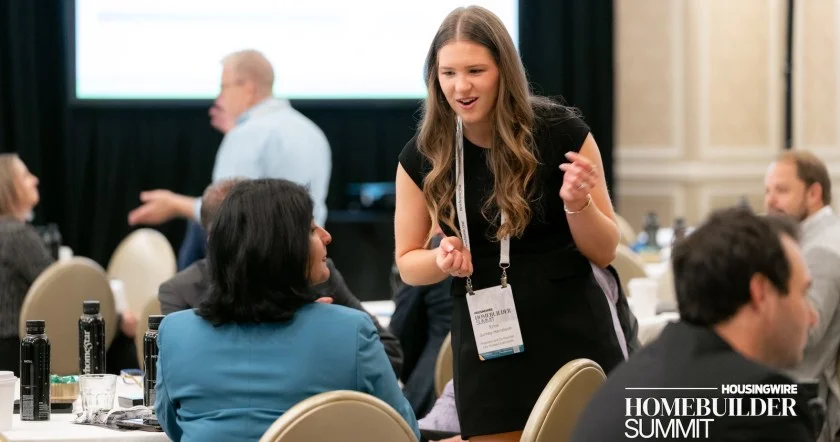
They came to learn from one another, challenge assumptions, share experiences and return to their businesses with greater clarity about the decisions, capabilities, and relationships that can make a difference when conditions run full of headwinds.
Clearly, business leaders recognize the stark distinction between growing bigger, and even growing more profitable, versus getting better as a company. They know that now there’s no way around getting better. They have to do that, or they won’t be around to grow bigger or make more money.
The sixth constraint
America needs more homes, some say millions more, but need does not make a home economically buildable. It doesn’t make land available, financing affordable, entitlement and permitting timely, labor plentiful, materials less expensive, or the monthly payment workable for the homebuyer customer.
NAHB Chief Economist Rob Dietz offers a useful way to map those pressures. He calls them the five Ls: lots, labor, lending, local approvals, and lumber, shorthand for the entire materials and supply-chain equation. The problem for homebuilders is that these are binding constraints, meaning that excellence in four of the five cannot necessarily compensate for an inability to manage the fifth. A company may have access to land and capital, dependable trade relationships, and an efficient purchasing operation, yet still find that the finished product is economically out of reach for the customer it intends to serve.
Another constraint, however, may be just as meaningful, particularly in an operating environment where relief from the five Ls remains uncertain. That constraint is the organization itself and its capacity to make sound decisions, learn quickly, execute consistently, adapt to changing conditions, and deliver what customers genuinely value.
A difficult market reveals what a company truly is. It exposes where profitable growth concealed weaknesses, where costs outpaced value, where communication broke down, where leaders became bottlenecks, and where customers were paying for things the company valued more than they did. Conditions that may have hidden those shortcomings during periods of strong absorption, rising prices, and relatively forgiving capital costs now put them in direct conflict with the economics of running a viable business.
For Schaefer Homes, this challenge is especially acute because the company is navigating a difficult market while transitioning from a founder-led enterprise to an organization capable of supporting significantly greater production. Schaefer’s ambition to double closings in 2027 and again in 2028 is not simply a sales or land-acquisition objective. It is a test of whether the company’s leadership structure, information systems, purchasing discipline, construction processes, customer relationships, and financial controls can mature quickly enough to support that growth without sacrificing the economics that make it worthwhile.
The dilemma Schaefer describes is one many young and mid-sized homebuilding businesses recognize. A company reaches a point where the founder’s judgment, relationships, stamina and personal involvement are no longer sufficient to manage every consequential decision, yet its revenue and earnings have not reached the level that would make a fully developed corporate operating infrastructure affordable.
It needs more specialized talent, better systems, more disciplined processes, and deeper capital relationships before it has the scale to pay for them comfortably.
This brings us to Jim Schaefer’s conversation with Jim Lemming. The immediate subject may have been construction-material take-offs, but the underlying issue was how to convert an experienced builder’s personal knowledge into a repeatable organizational process that can be taught, measured, improved, and scaled. The question is not simply whether Schaefer can build 80 homes next year. It is whether Schaefer Homes can become the kind of business that builds 80 homes reliably and profitably, and then has the capacity to build 160 without reinventing itself at every turn or risking its very existence.
Leadership as an operating advantage
Customer-experience strategist Joseph Michelli, who led an intensive leadership workshop during the Summit, added another L to the industry’s discussion of binding constraints: leadership. His contribution reinforced a premise that ran through the gathering’s conversations: leadership is the means through which organizations act on what they can control, even when they cannot control the circumstances around them.
For me, that leadership imperative comes down to five interdependent qualities: character, capability, collaboration, competitive fire, and customer-first culture. They are less a checklist of leadership virtues than the ingredients of an organization’s ability to withstand pressure, recognize opportunity, and translate learning into better performance.
Character is how leaders earn and sustain trust, especially when decisions are difficult and consequences extend beyond the executive suite to employees, trade partners, customers, and capital providers. Capability is how organizations turn talent, technology, information, and operational discipline into repeatable results. Collaboration is how individuals and businesses combine knowledge, experience, and perspectives to solve problems they may not be equipped to solve alone. Competitive fire is the determination to improve, win customers, and create value even when market conditions offer little assistance. A customer-first culture provides the ultimate measure of whether those efforts are directed toward what people genuinely need, want, and can afford.
Those qualities took different forms throughout the Summit’s discussions, reflecting that there is no single operating model or capital structure that defines a successful homebuilding business.
National HomeCorp Executive Chairman Wade Jurney’s approach to attainable housing reflects the discipline required to build a business around payment-sensitive customers, with cost control and the elimination of unnecessary complexity central to the value proposition. Signature Homes Chairman and Co-Founder Dwight Sandlin’s approach emphasizes product differentiation, customer experience, and execution to create demand even when affordability pressures give prospective buyers ample reason to hesitate. View Homes CEO Natasha Gandhi’s leadership agenda focuses on strengthening the company’s organizational and operating capabilities in anticipation of opportunities that may emerge beyond the current market.
The differences among those approaches are substantial, yet the underlying challenge remains the same.
Each business must determine what it can do better, how it can create greater value for its customers, and which organizational capabilities will matter most as the market eventually changes. The question is not whether a company can wait long enough for a more favorable demand environment, but whether it can use the present environment to become more capable, competitive, and resilient.
For young companies such as Schaefer Homes, the opportunity to learn directly from leaders who have faced those questions across multiple business cycles can accelerate the development of capabilities that might otherwise take years of trial and error to acquire.
Scale is earned before it becomes an advantage
One of the more consequential ideas to emerge from the Summit’s leadership conversations was that scale in homebuilding is both a source of competitive advantage and, in many respects, an outcome of earning the preference of the people whose decisions make a homebuilding business possible.
Taylor Morrison Chair, CEO, and President Sheryl Palmer has made becoming the homebuilder of choice a defining principle of the company’s leadership philosophy. That concept invites a broader understanding of scale than the number of homes a company closes or the volume of capital it can deploy.
Customers choose builders whose homes, value propositions, and service experiences earn their confidence. Employees choose organizations where they believe their contributions matter and where leadership offers opportunities to grow. Trade partners choose builders whose commitments, scheduling discipline, and business practices make them dependable partners. Land sellers, communities, lenders, and investors judge which organizations they can trust to deliver on their promises.
Those choices can create growth opportunities. Once achieved, scale can provide greater purchasing leverage, access to capital, investment in technology, specialized talent, and operating resources that enable the company to create even more value for those stakeholders. The relationship can become self-reinforcing, provided leadership continually turns the advantages of size into better experiences and stronger performance rather than allowing growth to produce bureaucracy, distance from customers, or organizational complacency.
This goes especially for those navigating the difficult transition Schaefer describes. A young company cannot simply buy all the advantages of a much larger competitor. It must earn opportunities to grow through the quality of its relationships, the reliability of its execution, and the value it delivers. At the same time, it must invest carefully in the systems and people that will enable it to fulfill those commitments at scale.
The danger is mistaking volume growth for organizational progress. More closings, more communities, and more revenue can mask deteriorating execution, weakening margins, and rising organizational complexity. Conversely, a business that learns to control waste, shorten cycle times, coordinate trades, understand customers, and make better capital-allocation decisions may become economically stronger before its production volume reflects that improvement.
That is the practical meaning of earning the right to grow, and it is one reason Schaefer’s conversations with more experienced builders were so consequential.
Getting better together
“My getting to sit in a chair at a round table that has Signature Homes CEO Dwight Sandlin — who runs a nearly half-billion-dollar business — and Bloomfield Homes CEO Don Dykstra — whose business is nearly a billion dollars a year — and National HomeCorp.’s chairman Wade Jurney — whose company is just five years in and already at $130 million and 550 homes — and they’re telling me ways they had to figure out the things I’m trying to get better in right now was mind-blowing,” Schaefer says.
The exchange illustrates something easy to overlook in an industry where companies compete fiercely for land, customers, labor, capital, and market share. The operating knowledge that enables a business to navigate difficult conditions is not always proprietary technology, a purchasing agreement, or a capital-market advantage. Sometimes it is a lesson learned through experience, an error avoided because someone else has already made it, or a different way of approaching a familiar problem.
Those lessons become especially valuable when the organizations exchanging them are at different stages of maturity. The founder of a young company brings urgency, adaptability, and an intimate understanding of the day-to-day consequences of decisions that larger enterprises may have institutionalized long ago. More experienced leaders bring perspective on what happens as businesses grow, systems strain, leadership responsibilities shift, and operating practices that worked at one scale no longer work at another.
That intergenerational and cross-company exchange was one of the Summit’s defining themes. Lemming’s leadership transition at Partners in Building, from his tenure as the company’s operating leader to his son Chris’s next chapter, underscored the importance of transferring judgment and experience without stifling the next generation’s capabilities and ideas. The same principle applies beyond family-owned companies to every organization seeking to prepare its next generation of leaders for an industry whose operating requirements continue to evolve.
It was also evident in Michelli’s workshop, where participants worked shoulder to shoulder at tables, sharing experiences and challenging one another to think more carefully about what their customers value and how their organizations can stay closer to those values.
That requires more than collecting customer data, conducting surveys, or asking salespeople to improve conversion rates. It requires the ability to translate what the business learns into decisions about land, product, pricing, purchasing, construction, communication, service, and the relationships that support each function.
It also requires a willingness to learn from people whose experiences differ from one’s own, which was precisely what the Summit participants were doing as they worked at those tables.
What the next 24 months will reveal
Nobody who gathered in Dallas was under any illusion that the road ahead would be anything but harsh. Mortgage-rate volatility, elevated development and construction costs, uncertain demand, capital constraints, labor challenges, and the persistent difficulty of delivering homes with monthly payments customers can afford are unlikely to disappear on a timetable convenient to homebuilding businesses.
For some companies, the next 12 to 24 months will primarily test liquidity, balance-sheet discipline, and the ability to preserve capital without making decisions that compromise their future. For others, including younger businesses with carefully considered growth ambitions, the challenge will be to make selective investments in people, systems, land, and operating capabilities while maintaining the flexibility to withstand further market disappointment.
In either case, waiting for outside help is not a strategy sufficient to the circumstances.
The heart and soul of the HousingWire Homebuilder Summit revealed itself midway through the gathering, when participants sat around tables and worked with two distinct yet related purposes.
One was to make the idea of improving their own organizations concrete and actionable, identifying the decisions, processes, capabilities, and relationships they could strengthen despite harsh present conditions and an uncertain future. The second was to ensure that the person next to them, whether from a young startup or a multibillion-dollar enterprise, came away better equipped to do the same.
That second commitment distinguishes the gathering from a conventional exchange of forecasts, market intelligence, and executive viewpoints. The people in the room were not simply sharing what they knew. They were investing time and experience to help one another improve at what they do, recognizing that the industry’s capacity to serve American households ultimately depends on the strength of the businesses and people responsible for building homes.
Signature Homes’ Dwight Sandlin summed it up: “We all learned so much and connected with some great resources.”
Which brings us back to Jim Schaefer, his dumpsters full of unused construction materials, and his ambition to double Schaefer Homes’ production in 2027 and again in 2028.
The external conditions that could complicate that ambition are substantial, and Schaefer makes no claim that his company can wish them away. What he can do is improve the quality of the information his team uses to make decisions, the accuracy of its purchasing, the consistency of its construction processes, the effectiveness of its leadership, and the organization’s ability to learn from mistakes before they become more costly at greater scale.
And he can shorten the distance between what his company knows today and what it needs to know tomorrow by spending time with people who have already traveled parts of the road ahead.